How Much Muriatic Acid Do You Need to Lower Pool pH?
The amount of muriatic acid needed to lower the pH in pool water depends on your pool’s gallons and your starting pH. As a practical starting point, many home pools need roughly 12 to 60 ounces based on pool size and how high the pH is, then you circulate, retest, and adjust.
To bring those pH fundamentals into a real-world dose you can use, start with your pool volume and current test result, then use our guide to calculate how much muriatic acid to add safely.
Major Takeaways
✔ Dose by pool gallons and starting pH; circulate, then retest.
✔ Typical starting range is 12–60 oz, depending on pool size and pH.
✔ Target pH is 7.0–7.8 with at least 2 ppm chlorine.
✔ Avoid low pH; small overdoses can trigger corrosion.
✔ Add with the pump running and distribute slowly for even mixing.
Why Pool pH Matters
Before figuring out the amount of muriatic acid needed to lower pH in pool water, it helps to know what pH is doing behind the scenes. Your pH influences how well chlorine disinfects, how comfortable the water feels, and how long your pool surfaces and equipment last.
What pH Is
pH is a measure of how acidic or basic water is on a scale from 0 to 14. Your pool’s pH levels change with rainfall, splash-out and refill water, swimmer load, sanitizer type, and even aeration from waterfalls or spa spillovers.
Ideal pH Range for Most Home Pools
For home pools and hot tubs, the CDC recommends keeping pH between 7.0 and 7.8 and maintaining a chlorine concentration of at least 2 ppm. Keeping your pH levels in that range helps chlorine do its job more effectively and supports swimmer comfort while reducing unnecessary wear on pool components.
What Happens When pH Is Too High
High pH levels can reduce chlorine’s ability to kill germs and may contribute to cloudy water or scale. The CDC specifically notes chlorine becomes less effective as pH increases, especially above 8.0.
What Happens With Low pH
Low pH is where damage risk rises fast. The CDC notes that as pH goes down, especially below 7.0, pipes are more likely to corrode or break down. A small overdose can create low pH conditions that attack metal fixtures, heaters, ladders, rails, and other components.
How Much Muriatic Acid to Lower pH in Pool Water
Use this chart as a starting-point guide to estimate muriatic acid is required based on your current reading and pool size. Because small amounts can significantly affect pH, it’s smartest to dose conservatively, keep the pump running, and retest before adding more.
| Starting pH | 10,000g Pool | 15,000g Pool | 20,000g Pool | 25,000g Pool |
|---|---|---|---|---|
| 7.6 - 7.8 | 12 oz | 18 oz | 24 oz | 30 oz |
| 7.8 - 8.0 | 16 oz | 24 oz | 32 oz | 40 oz |
| 8.0 - 8.4 | 24 oz | 1.5 qt | 48 oz | 60 oz |
How to Use the Chart Correctly
This chart works best when you treat it like a measured starting point, not a one-and-done dose. Use these checkpoints to make sure you are matching the right amount to your pool and avoiding an accidental swing into low pH.
- Match gallons first: Muriatic acid requirement changes drastically between 10,000 and 25,000 gallons.
- Match starting pH next: Use a reliable test method so your pH levels are real, not a guess.
- Dose in rounds: If you are new to balancing water, cut the chart dose in half, circulate, then retest before finishing the second half. This is a simple way to avoid low pH.
- Retest after mixing: Acid needs time and circulation to distribute evenly, which affects how accurately you can lower pH in pool water.
Example (15,000 gallons, pH 7.9): The chart suggests 24 oz. Add 12 oz first, circulate, retest, then decide if you need the remaining 12 oz so you do not overshoot and drop the pH too far.
How to Lower pH in Pool Safely Step-by-Step
The process for lowering pool pH is simple, but it’s also easy to overdo. Because muriatic acid can shift the water quickly, the safest approach is to measure carefully, keep water moving, and retest before adding more.
Step 1: Confirm Your Readings (Don’t Treat Guesses)
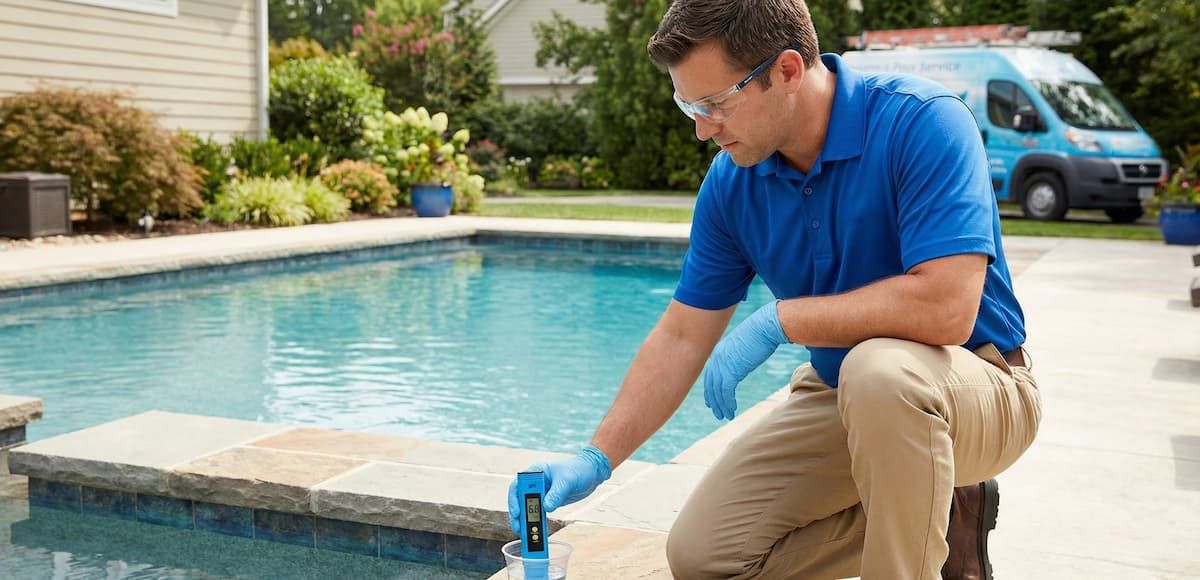
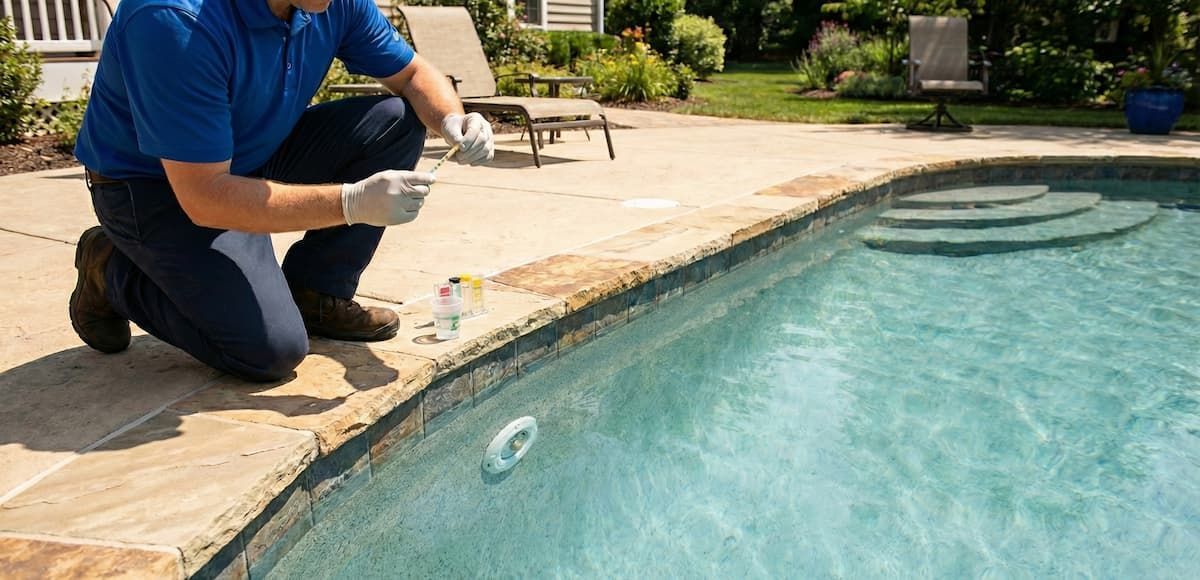
Test your pH with a reliable kit and record the result. If you can, test total alkalinity as well since it affects how stable your pH will be after you make an adjustment. If your reading seems surprising, retest to confirm before adding anything.
Step 2: Calculate a Conservative Dose
Use a dosage chart based on your pool gallons and current pH. If you’re estimating volume, start smaller than you think you need. A half-dose first is a smart “test dose” that reduces the chance of dropping the pH too far.
Step 3: Add Muriatic Acid Correctly
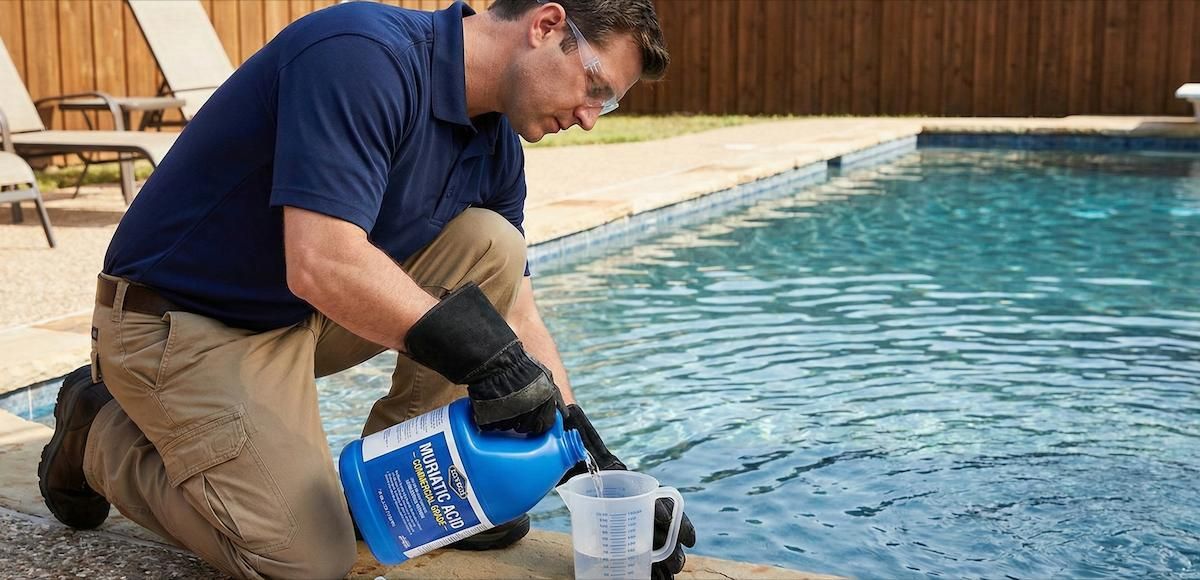
Muriatic acid needs careful handling. Use basic protection (like gloves and eye protection), work upwind, and keep kids and pets away while you pour.
- Turn the pump on so the water is circulating.
- Pre-measure the exact amount before you start.
- Walk the pool perimeter and pour slowly to help it disperse evenly.
- Avoid splashing coping, patio blocks, and nearby surfaces. If you spill, rinse immediately with plenty of water to reduce the chance of discoloration or damage.
Step 4: Circulate, Wait, Retest
Keep the pump running to fully mix the water. Retest after a few hours, then decide whether you need a small follow-up dose. This “add, mix, test” rhythm is how you dial in the result without overshooting.
Step 5: Rebalance if You Overshoot
If the pH drops too low, stop adding acid. Circulate, retest, and raise pH gradually using a standard pH increaser or other appropriate method. Avoid large back-and-forth corrections since repeated swings can stress pool finishes and shorten the life of certain equipment.
How to Raise pH in Pool (If You Added Too Much Acid)
Overshooting is common because muriatic acid can move the needle fast. If your pH drops below your target range, the goal is to bring it back up slowly and avoid a rebound that sends you right back into high pH.
When to Raise pH
If your test shows the pH is low compared to your target range, stop adding acid. Keep the pump running, let the water fully mix, then retest to confirm the reading is real and not a localized “hot spot” from recently added chemicals.
What to Use to Raise pH
A standard “pH increaser” is typically soda ash and is designed to raise pH efficiently. Aeration can also increase pH in some pools by driving off carbon dioxide, often with less impact on alkalinity depending on your water balance. Pick one method and stick with it so you can clearly see how your water responds.
Steps to Raise pH Safely
Treat this like a gradual correction, not a quick fix, so you can avoid overshooting and creating a second swing in the opposite direction.
- Add a small, measured amount of pH increaser.
- Circulate for a few hours to distribute it evenly.
- Retest and repeat in small increments until you’re back in range.
Common Mistakes Homeowners Make With Muriatic Acid
Muriatic acid is effective, but it’s also unforgiving if you rush. Most problems come from moving too fast, skipping a retest, or trying to correct everything in one pour.
Adding Too Much at Once
A large single dose can drop pH farther than intended and push the water into a corrosive range. Once that happens, you’re no longer “fixing high pH,” you’re recovering from low pH and trying to protect metal parts and finishes from exposure.
Testing Too Soon
Acid needs time to mix evenly. Testing before full circulation can make the pH look lower or higher than it really is, which leads to bad decisions, including stacking additional chemicals that were not needed.
Pouring in One Spot
Dumping acid into one location can create a highly concentrated pocket that may irritate plaster, liners, or nearby materials. Slow, distributed pouring with circulation helps prevent localized hotspots.
Ignoring Total Alkalinity
Total alkalinity acts like a buffer. If it’s high, pH can bounce back quickly and tempt you into repeated acid additions. If it’s low, pH can become unstable and swing easily. Either way, ignoring alkalinity often turns a simple adjustment into an ongoing cycle.
Treating pH Correction as a One-Time Fix
Most pools do best with routine testing and small course corrections. Trying to “solve it for the season” with a dramatic adjustment usually creates a swing in the other direction and adds more work later.
Frequently Asked Questions (FAQs)
How to lower pH in a pool quickly?
Test pH, then add a measured dose of muriatic acid based on pool gallons and current pH with the pump running. Circulate for a few hours, retest, and only add a small follow-up dose if needed.
Do I run the pump when adding muriatic acid to the pool?
Yes. Keep the pump on while adding acid and run it for several hours afterward so the acid disperses evenly and you get an accurate retest.
What happens if you put too much muriatic acid in the pool at once?
pH can drop into low pH fast, which increases corrosion risk for heaters, rails, ladders, and other components, and can irritate swimmers. You’ll typically need to circulate, retest, and raise pH gradually; severe overshoots may require partial drain and refill.
How long do I need to wait to get in the pool after adding muriatic acid?
Wait until the water has circulated for a few hours and pH tests back in range. Retest before swimming instead of relying on a fixed time.
What pool chemicals cannot be added at the same time?
Don’t add chemicals together or back-to-back in the same spot. Keep muriatic acid separate from chlorine/shock products and space additions out with circulation time between them to avoid reactions and bad readings.
Need Help With Pool Upgrades or Repairs in Danbury, CT?
If your pool chemistry keeps swinging or you are planning improvements around your pool area, it helps to look at the whole system: circulation, surfaces, drainage, decking, and how the space gets used.
For
Danbury, CT, homeowners considering renovations connected to swimming pool construction and long-term durability,
FJV Construction can be a local starting point for planning and project guidance.
To learn more about swimming pool construction services,contact FJV Construction today.