Pool Equipment Repair in Brookfield, CT: Problems & Fixes
What’s In This Guide
- What Are the Most Common Pool Equipment Problems in Brookfield, CT?
- How Do You Troubleshoot Pool Equipment Problems Before Calling a Repair Technician in Brookfield, CT?
- When Does Pool Equipment Repair Require a Licensed Professional in Brookfield, CT?
- Frequently Asked Questions
- Schedule a Pool Equipment Repair Assessment in Brookfield, CT
Pool equipment rarely fails at a convenient time. One afternoon everything runs fine, and the next morning the pump is making a noise it never made before, the water looks off, or the heater simply will not respond. For homeowners in Brookfield, CT, that kind of problem needs a clear answer fast, not a guessing game.
Here are the most common pool equipment problems, what causes them, and what homeowners should check before calling a repair technician.
Quick Facts
- Pool equipment repair in Brookfield, CT comes down to knowing the symptoms, the cause, and when to call a professional.
- Filter pressure 8 to 10 PSI above baseline signals an overdue cleaning or backwash
- Gas, electrical, and certain motor or plumbing repairs should be handled by a licensed Connecticut professional.
- One failing component puts strain on the entire pool system
What Are the Most Common Pool Equipment Problems in Brookfield, CT?
Pool equipment problems fall into four main categories: pump failures, filter issues, heater malfunctions, and circulation problems. Each category produces distinct symptoms that point to a specific cause.
Noisy, Weak, or Failing Pool Pumps
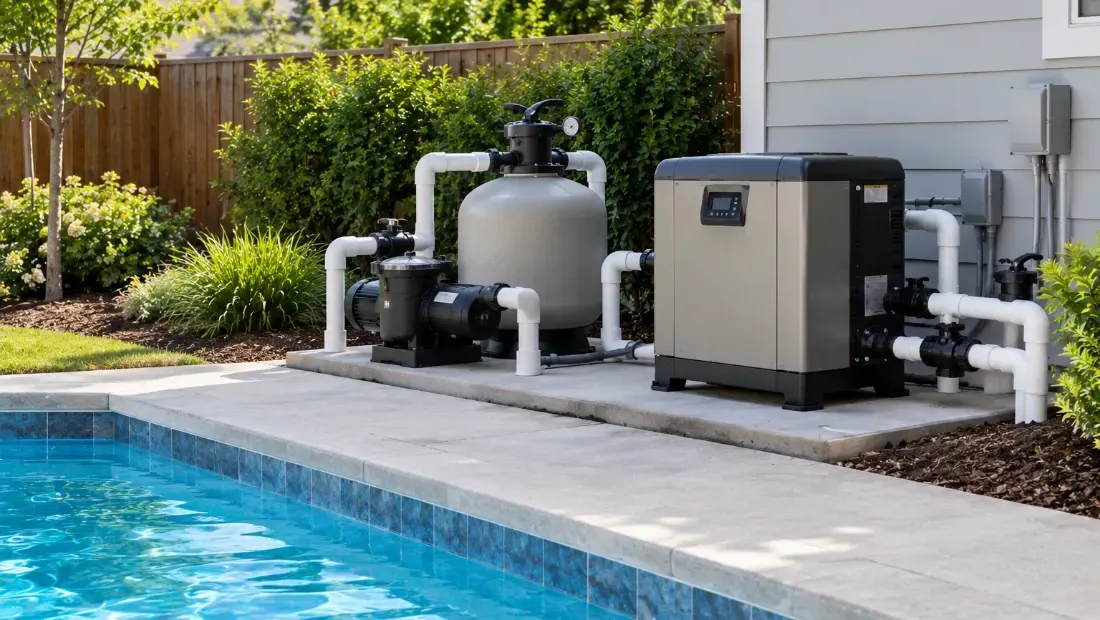
A pool pump that runs loudly, loses suction, or fails to circulate water properly may need pool pump repair in Brookfield, CT. The most common causes are air infiltration, a clogged impeller, or worn motor bearings. Pumps older than 10 years that show multiple symptoms may be better candidates for replacement than continued repair.
Common causes of pool pump failure:
- Cavitation noise (high-pitched squeal or grinding): Air is entering the suction line, usually through a cracked lid O-ring or a loose fitting at the pump housing.
- Loss of prime: Water level is too low, or the skimmer basket is fully blocked, starving the pump of adequate flow.
- Weak water flow despite normal motor operation: The impeller is clogged with debris and needs to be cleared or replaced.
- Grinding or humming with no water movement: Motor bearings are worn, and the motor assembly likely requires full replacement.
➤ READ NEXT:
The Best Pool Pump Settings to Maximize Energy Savings
Cloudy Pool Water Caused by Filter Problems
Cloudy water can point to filtration issues, chemical imbalance, or a combination of both. If the water remains unclear after basic treatment, a filter repair may be necessary.
Keeping
pool pH roughly between 7.0 and 7.8 helps support sanitizer performance, protects pool equipment and plumbing, and keeps the water more comfortable for swimmers.
Filter repair may involve checking several common failure points:
- Sand filter channeling: Water bypasses the sand media through channels rather than flowing through it. A full backwash or complete media replacement corrects this.
- Torn or worn cartridge filter element: A damaged cartridge cannot capture fine particles. Cartridge elements typically last 1 to 3 seasons with proper care.
- DE filter grid damage: A broken diatomaceous earth grid allows unfiltered water to return to the pool, creating a persistent haze.
- Insufficient filtration run time: Filtration run time should be long enough to properly circulate and filter the pool based on size, equipment, and usage. Short run cycles leave suspended particles in the water column.
Pool Heaters That Fail to Start or Hold Temperature
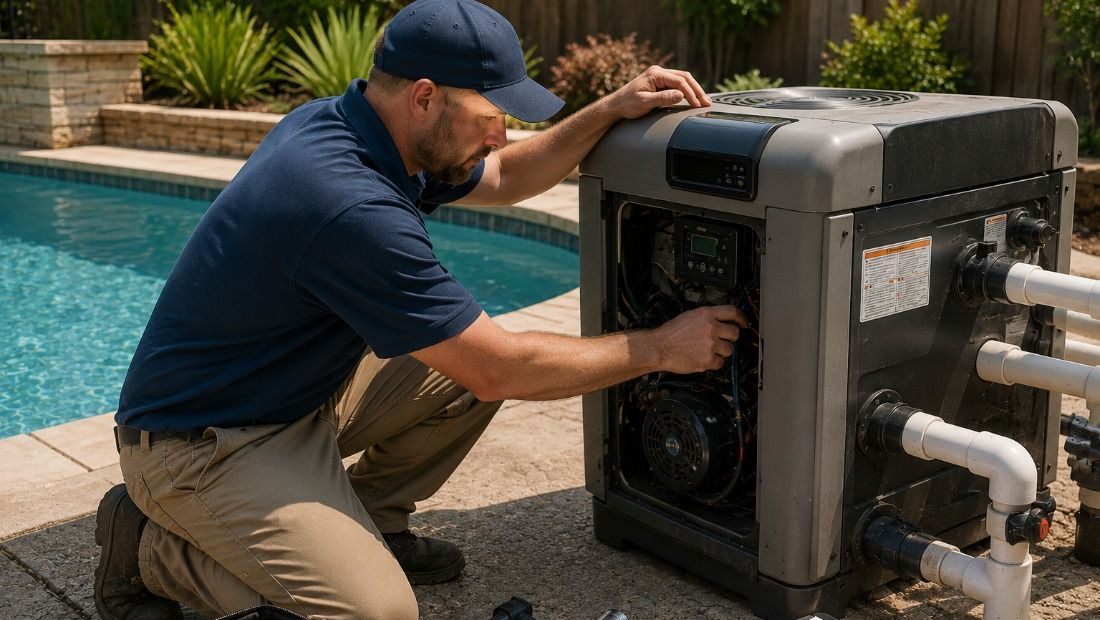
A pool heater that fails to ignite or cannot maintain temperature may need repair, replacement, or professional heater installation depending on the issue. Most problems relate to the ignition system, thermostat calibration, water flow rate, or heat exchanger condition.
Diagnostic checklist for pool heater failure:
- No ignition on a gas heater: Check whether the pilot light has gone out or whether the gas supply valve is fully open before assuming a mechanical fault.
- Thermostat set below current water temperature: Confirm the thermostat setting exceeds the actual pool water temperature before calling for service.
- Flow switch fault: Pool heaters require a minimum flow rate to activate the heating cycle. A clogged filter or reduced pump speed can prevent the flow switch from triggering.
- Heat exchanger scale buildup: Hard water deposits restrict heat transfer efficiency. Professional descaling may help extend heater lifespan when scale buildup is present.
- Gas line pressure problems: An undersized gas line or a partially closed supply valve reduces burner performance and can prevent full ignition.
If the unit is aging, inefficient, or repeatedly failing, heater installation may be more practical than another repair.
Low Water Pressure and Poor Pool Circulation
Low pressure at the return jets indicates restricted flow somewhere between the skimmer and the pump. The cause is usually related to flow restriction, air infiltration, or equipment condition and can often be traced systematically.
Causes ranked from most to least common:
- Clogged skimmer or pump basket (check this first, every time)
- Dirty filter cartridge or sand filter media requiring backwash
- Air leak at the pump lid O-ring or suction fittings
- Partially closed or stuck valve on the suction line
- Clogged or damaged impeller inside the pump housing
| Symptom | Likely Cause | Recommended Action |
|---|---|---|
| Noisy or vibrating pump | Air leak, worn motor bearings, clogged impeller | Professional inspection |
| Cloudy water after chemical treatment | Dirty, bypassed, or damaged filter media | Backwash or replace filter element |
| Heater not starting | Ignition failure, thermostat fault, gas supply issue | Licensed technician required |
| Low return jet pressure | Clogged skimmer basket, dirty filter, air leak | Check skimmer first, then filter |
| Pool losing water near equipment | Pump seal failure or plumbing leak | Pressure test by a professional |
How Do You Troubleshoot Pool Equipment Problems Before Calling a Repair Technician in Brookfield, CT?
These steps allow homeowners to identify the issue accurately and avoid unnecessary service calls for problems that have straightforward fixes.
Step 1: Clear the Skimmer and Pump Baskets
Remove all debris completely. A blocked basket is one of the most common causes of reduced flow and pump strain, and addressing it early may help avoid more extensive pool pump repair in Brookfield, CT.
Step 2: Read the Filter Pressure Gauge
Note the current reading and compare it to the normal baseline recorded at the last cleaning. A reading 8 to 10 PSI above baseline means the filter needs immediate attention.
Step 3: Inspect the Pump Lid and O-Ring
Look for cracks, warping, or debris sitting in the O-ring groove. Air entering at the lid causes prime loss and cavitation.
Step 4: Check All Valves
Confirm every valve on the suction and return lines is fully open. A single partially closed valve cuts flow significantly.
Step 5: Verify the Pool Water Level
The water line should sit at the midpoint of the skimmer opening. Water below that point causes the pump to draw air and lose prime repeatedly.
Step 6: Check Heater Settings and Power Supply
Confirm the thermostat is set above the current water temperature and verify the circuit breaker has not tripped before assuming a mechanical fault.
Step 7: Run a Complete Pump Cycle and Recheck
After completing steps 1 through 6, run the system through a full filtration cycle and observe pressure readings, return jet flow, and heater behavior. If the problem persists, document the symptoms and contact a qualified pool equipment repair technician.
When Does Pool Equipment Repair Require a Licensed Professional in Brookfield, CT?
Some pool equipment repairs carry real safety risk when handled without proper licensing. Connecticut state licensing requirements exist to protect homeowners and ensure code-compliant work on systems that involve electricity, gas, and pressurized plumbing.
Repairs that require a licensed professional:
- Gas supply line work, valve replacement, or burner assembly service on any pool heater
- Electrical wiring, panel connections, GFCI outlet installation, or motor replacement
- Pump seal replacement involving disassembly of sealed motor components
- Structural plumbing leaks requiring cutting and resealing pipe runs underground or inside equipment pads
- Heat exchanger replacement on gas, propane, or electric pool heaters
- Automation system wiring and digital controller installation
What Happens When Homeowners Attempt These Repairs Themselves?
DIY repairs on licensed-scope work carry consequences that go beyond a failed fix.
Voided Warranties
Many pool equipment warranties can be affected by improper repairs, unauthorized service, or non-code-compliant work. Homeowners should review warranty terms before attempting repairs themselves.
Failed Inspections
Unpermitted or non-code-compliant work can trigger failures during routine pool inspections, requiring the repair to be redone correctly at additional cost.
Safety Hazards
Improperly repaired electrical systems near water are a documented hazard. Gas line errors can go undetected until the situation becomes dangerous. Connecticut's Department of Consumer Protection enforces licensing requirements specifically because these risks are real.
Hidden Damage
A repair that appears to work initially can leave underlying issues that surface later under worse conditions, often damaging other components in the process.
Frequently Asked Questions
How much does pool equipment repair cost?
Repair costs vary depending on the component, the severity of the issue, and whether parts need replacement. Minor fixes are generally low cost, while motor replacements or heater repairs can run higher. Contact a licensed local contractor for an accurate estimate before committing to any repair work.
How often should pool equipment be serviced?
Most pool equipment benefits from at least one professional inspection per year. Filters and baskets need more frequent attention during the active swim season. A consistent pool maintenance service prevents small issues from becoming larger, more expensive problems.
Can pool designers near me in Brookfield, CT help with equipment planning?
Yes. Pool designers near Brookfield, CT can help homeowners find local professionals who understand how pool layout, equipment placement, and long-term pool maintenance service work together. The right pool designers can also help identify whether recurring equipment issues are tied to older design choices, undersized systems, or poor circulation planning.
Can one failing component damage the rest of the pool system?
Yes. Pool equipment operates as a connected system. A failing pump puts strain on the filter and heater, and a clogged filter reduces flow to every downstream component. Addressing one problem early often prevents secondary damage to equipment that was functioning normally.
Is it worth repairing older pool equipment or better to replace it?
Age, repair history, and the cost of the fix relative to replacement value all factor into that decision. Equipment that has required multiple repairs within a short period, or that is approaching the end of its expected lifespan, is often more cost-effective to replace than to repair again.
Schedule a Pool Equipment Repair Assessment in Brookfield, CT
When pool equipment starts showing signs of trouble, the right move is a professional assessment before the problem spreads to other parts of the system. FJV Construction works with residential pool owners across Brookfield, CT, and surrounding communities, providing licensed and insured repair, pool maintenance service, and installation for all major pool equipment.
Our team understands the local conditions that affect pool systems in Fairfield County and Litchfield County, from water chemistry to seasonal wear, and brings that working knowledge to every job.
Contact FJV Construction today to schedule a pool equipment assessment.